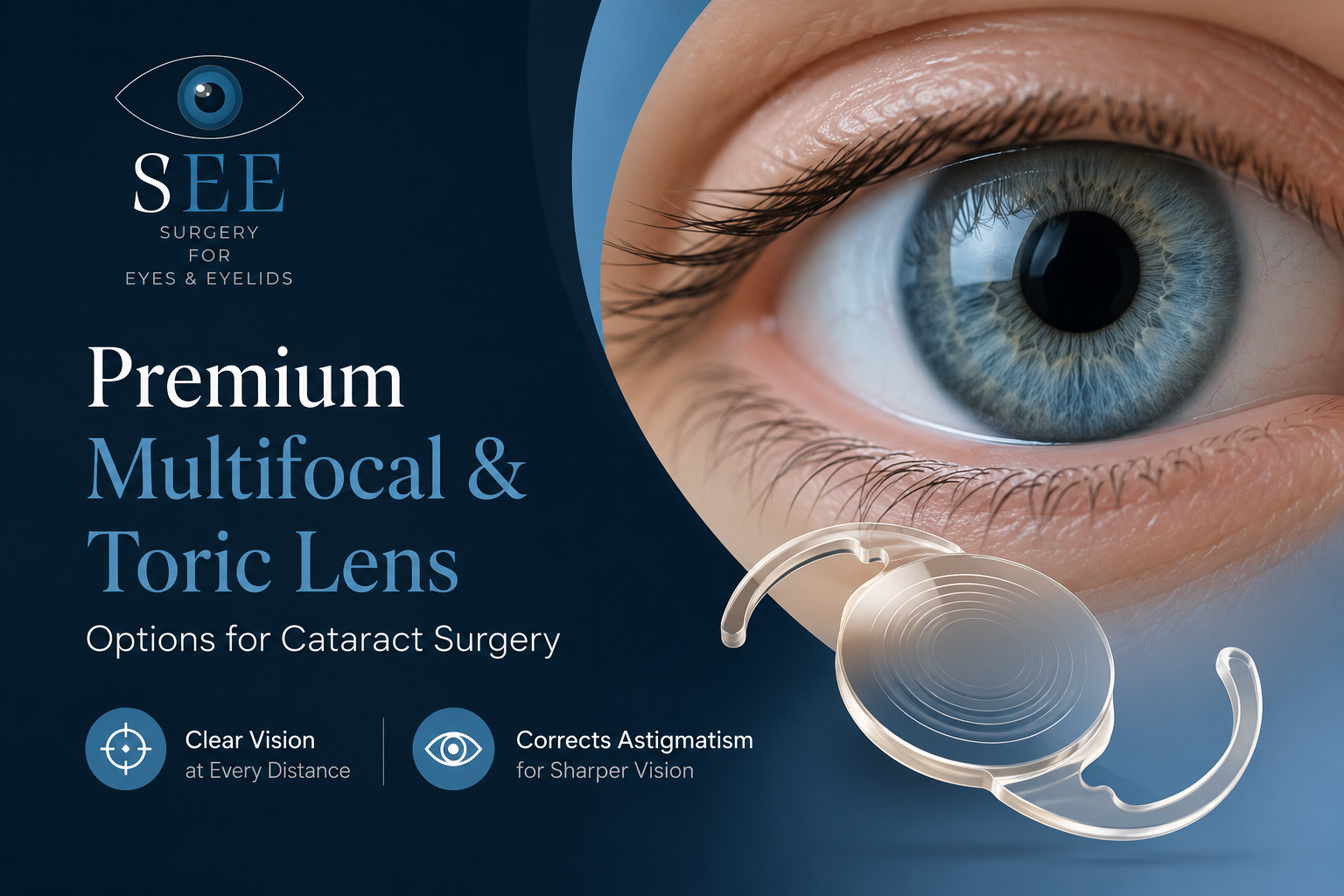
The procedures carried out during cataract surgery have transcended beyond simply improving cloudy vision. Cataract surgery has now provided people with an avenue to obtain crystal-clear vision that has remained elusive in some cases over the years, all without having to wear corrective glasses anymore.
If you are experiencing problems related to age-related cloudy vision, light sensitivity, and even blurred vision, among other issues, modern techniques used in eye cataract treatment have made it possible for all such conditions to be handled simultaneously. The secret lies in the use of advanced cataract lenses like multifocal and toric intraocular lenses.
The surgeons at Eyes and Eyelids will help you choose the right cataract lens implants based on your needs. Learn more about these lenses by visiting our website at www.eyesandeyelids.co.uk.
Key Takeaways
- Today cataract treatment also involves the choice of advanced lenses, which can help you see at all three distances – far, intermediate, and close – at once.
- Toric intraocular lenses are used exclusively to treat astigmatism in corrective eye cataract surgery, thereby making the use of glasses post-surgery unnecessary in most cases.
- Astigmatism cataract surgery with toric lenses will provide more accurate results compared to conventional monofocal lenses.
- The use of multifocal lenses minimises dependency on reading glasses as well as distance eyeglasses following the eye cataract treatment.
- Lens selection is a process that requires a comprehensive examination before the surgery.
How Do Multifocals Work?
Multifocal IOLs have optical zones that radiate from the centre and focus light into multiple focal lengths, such as near, intermediate, and distant distances. Through this technology, the brain is capable of changing the focal length depending on your focus.
Advantages of multifocals are:
- Freedom from glasses for both close-up and distance work
- Better contrast and vision at different focal lengths
- High quality of life especially if you are an active person
- Permanence, since these lenses will last throughout one’s lifetime
- Best suited for those who have no problem with their corneas
What Is a Toric Lens, and When Is It Used?
Toric IOL is a type of intraocular lens made specifically for correcting astigmatism, which is a refractive problem that arises because of the abnormal curvature of either the cornea or the lens. For those suffering from astigmatism, their vision will be blurry no matter how far or close the object is, and conventional treatment of cataracts would not help solve the problem.
Astigmatism cataract surgery using toric lenses corrects both the cataract and the refractive error simultaneously. The lens is aligned precisely to counteract the corneal irregularity, resulting in sharper, more stable vision after recovery.
Who Are the Right Candidates for Toric IOLs?
Not all patients need a toric intraocular lens, although those who have astigmatism, even minor cases, might get a lot out of going with this type of lens in their corrective eye cataract surgery.
If any of the below apply to you, you may be a good candidate for toric lenses:
- Astigmatism diagnosed either through your cornea or lens
- Use of toric contact lenses and/or cylindrical eyeglasses
- Interest in reducing your dependency on eyeglasses after the surgery
- A relatively stable topography of your cornea verified pre-operatively
Desire for maximum visual acuity after your astigmatism cataract surgery
Multifocal vs. Extended Depth of Focus (EDOF) Lenses: What’s the Difference?
Extended Depth of Focus (EDOF) lenses belong to the group of premium IOLs which deliver elongated continuous focusing rather than discrete zones of focus. Unlike multifocal lenses, EDOF lenses decrease the occurrence of halos and glare while ensuring sharp distance and intermediate vision.
EDOF lenses are highly recommended to individuals who:
- Spend much of their time looking at computer screens
- Drive a lot and suffer from nightglare
- Place importance on smooth transition in vision in varying ranges
- Are concerned about intermediate vision only
Are Premium Lenses Compatible with Laser Vision Correction Surgery?
Yes, in certain cases, a surgeon might opt for laser correction after the removal of a cataract from the patient’s eye in order to adjust the final outcome of the refractive procedure. This usually happens when the individual’s eyes still have some prescription left after surgery.
The combination of advanced cataract lenses and laser vision correction will enable the patient to attain the highest level of unassisted vision.
Which Lenses Are Chosen for Each Patient?
Choosing lenses is never a standard procedure. Several considerations need to be made:
- Corneal topography to check for astigmatism or irregularities of the cornea
- Measuring axial length to determine the power of the lens
- Lifestyle and vision preference – near, intermediate or distance vision
- Pupil size and corneal health – both of which may limit multifocality
- Previous refractive surgery which may affect calculations of the IOL
Clouded Vision to Crystal Clarity
The process of regaining clear and sharp vision after cataract surgery starts with selecting the best lens and a competent professional for the procedure. Patients now have access to results that they never saw. Whether you need to correct astigmatism or be free of reading glasses, or want to explore advanced lenses for cataract eye treatment, a consultation with a professional would certainly help you out!
Experience our competent surgical team at Eyes and Eyelids, in conjunction with the latest technologies of premium IOLs, in providing individualised and evidence-based solutions to your cataract surgery needs. Get your consultation today at The SEE Clinic.
Frequently Asked Questions.
Which type of lens would be used for cataract surgery?
Your doctor will suggest the best lens for cataract surgery based on your personal preference, level of astigmatism, and desired results after a thorough evaluation.
Is it painful to perform an astigmatism cataract surgery?
No, the operation takes place with local anaesthesia and involves no pain; just minor discomfort after it.
Do premium lenses wear out?
Premium lenses are made to last for life and should not wear out under regular conditions.
Will I still need glasses after multifocal lens surgery?
Most patients are able to stop using glasses after surgery or reduce dependency on them considerably.
Can I have corrective cataract eye surgery on the NHS?
Cataract surgery itself can be done on the NHS, but lens upgrades cannot, so you should pay for them yourself.