Objective:
Help readers understand when drooping or heavy eyelids cross the line from a cosmetic concern into a genuine vision problem, how blepharoplasty for peripheral vision works, and what to expect from assessment through to results, so they can decide with confidence whether the procedure is right for them.
Key Takeaways
- Drooping eyelids affecting vision are usually caused by excess upper lid skin (dermatochalasis) or a weak lifting muscle (ptosis), and the two often overlap.
- A visual field test can confirm whether heavy eyelids affecting vision are cutting into your upper and outer sight, rather than you simply feeling tired.
- Blepharoplasty for peripheral vision removes or repositions the tissue causing the obstruction, usually under local anaesthetic in under an hour.
- Most patients notice a wider field of view within days, with the full result settling over six to eight weeks.
- If eyelids blocking vision is confirmed by a visual field test, the surgery may qualify for NHS funding rather than being classed as purely cosmetic.
- At The SEE Clinic, assessment and surgery are carried out by consultant oculoplastic surgeons, not general cosmetic practitioners.
You notice it in small moments first. A car appears at the edge of your vision later than it should. You tilt your head back to read a menu instead of just glancing down. Somebody waves from the side and you miss it completely.
Most people put this down to tiredness or getting older in general. Often it isn’t either. It’s the eyelid skin itself, sitting lower than it used to and physically blocking part of what you’d normally see.
Some patients only realise how much they’ve adapted once it’s pointed out to them. They’ve been raising their eyebrows all day without noticing, or turning their whole head to check a blind spot instead of glancing sideways. The habit builds up slowly enough that it feels normal, right up until someone asks why their forehead looks permanently tensed.
This is one of the more overlooked reasons patients come to see us. Drooping eyelids affecting vision is a recognised medical issue, not just a cosmetic one, and it has a well-established surgical fix.
When Eyelid Skin Becomes a Vision Problem
Not every heavy eyelid is a medical concern. It becomes one once the skin or the lid margin drops far enough to sit within your normal line of sight.
The eyelid can droop for a few different reasons:
- Loss of skin elasticity and collagen with age
- A weakened muscle that lifts the upper lid, known as ptosis
- Fat and skin gathering above the eye, called dermatochalasis
- Sun damage, which speeds up skin laxity over the years
- Previous eye surgery or long-term contact lens wear, in some cases
- A family tendency towards low-set brows or heavier lids from an earlier age
What separates a cosmetic issue from a functional one is where the skin actually sits. If it stops well above your pupil, it’s a look. If it reaches your pupil or your upper visual field, it’s affecting how much you can actually see.
Patients often describe heavy eyelids affecting vision as feeling like they’re peering out from under a curtain. Reading, driving, and screen work are usually the first activities to suffer, since all three depend on a steady, unobstructed view rather than the wider glance you’d use walking down the street.
There’s also a practical safety angle that’s easy to miss. Checking a mirror before changing lanes, or spotting someone stepping off a kerb to your side, both rely on peripheral vision working properly. Patients often mention driving as the moment they first took the problem seriously, rather than the mirror at home.
How a Visual Field Test Works
A visual field test measures exactly how much of your side and upper vision is blocked, rather than relying on how you feel your eyes are working.
What actually happens during the test? You sit in front of a bowl-shaped machine called a Humphrey Field Analyzer and press a button each time you see a flash of light.
The test itself is simple:
- You rest your chin on a support with one eye covered at a time.
- Small light spots flash at different points around your field of view.
- You click a button whenever you spot one.
- The machine maps out where your vision responds and where it doesn’t.
- The test is repeated with your eyelids taped up, showing your vision without the drooping skin in the way.
That last step matters most. Comparing the two results shows your surgeon exactly how much vision the eyelid itself is taking away, and it forms part of the documentation needed if you’re hoping for NHS funding.
The test takes about ten minutes per eye and doesn’t hurt. No drops, no discomfort, just a series of flashes and a button.
Some patients are surprised by how objective the results are. It’s easy to assume your vision is “probably fine” because you’ve adjusted around the problem without realising it, but the printout doesn’t adjust. It shows the exact shape of what’s missing, usually a bite taken out of the upper field, sometimes extending further to the side than expected.
This is also why a proper assessment matters more than a quick look in a mirror. Two people can have eyelids that look similarly heavy, yet one has a measurable vision problem and the other doesn’t. The test settles that question with numbers rather than guesswork.
Drooping Skin vs a Weak Eyelid Muscle
Is my droopy eyelid caused by skin or muscle? It depends on the case, and quite often it’s both at once, which is why an assessment matters more than guessing from the mirror.
Excess skin, known as dermatochalasis, is a fold of loose tissue sitting above the lash line. A weak muscle, known as ptosis, means the lid margin itself sits too low, sometimes with the pupil partly covered even when the skin is pulled out of the way.
- Dermatochalasis: Caused by ageing skin and gravity. Fixed with standard upper blepharoplasty.
- Ptosis: Caused by a stretched or weakened levator muscle. Fixed with a ptosis repair, which tightens the muscle itself.
- Combined cases: Both are addressed in the same operation when needed.
Getting this distinction right matters, because removing skin alone won’t help a lid that’s drooping due to muscle weakness. Your surgeon will check both during consultation, usually by measuring how far your lid opens and how well the muscle responds when you look up.
| Dermatochalasis | Ptosis | |
| What’s happening | Excess skin folds over the lid | The muscle lifting the lid has weakened |
| Common cause | Ageing, sun exposure, genetics | Muscle stretching, nerve issues, previous surgery |
| Fix | Standard upper blepharoplasty | Ptosis repair, tightening the levator muscle |
| Vision effect | Helps once the overhanging skin is gone | Helps once the lid margin itself is raised |
Some patients arrive expecting a straightforward skin removal and discover during assessment that a weak muscle is also part of the picture. That’s a normal finding, not a complication, and it’s simply built into the surgical plan from the start.
How Blepharoplasty Restores Your Field of View
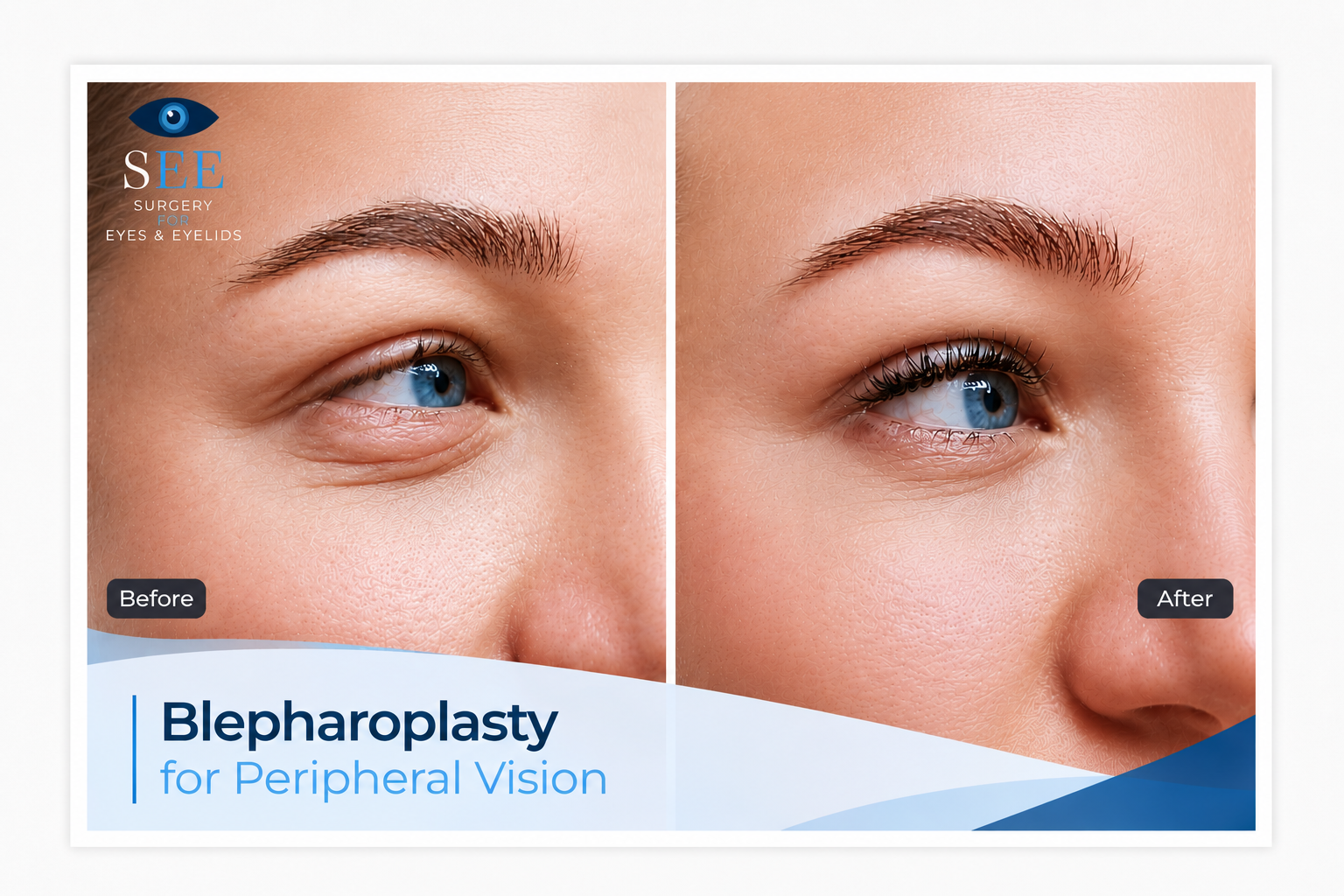
Upper blepharoplasty removes the tissue that’s physically sitting in your line of sight, following the natural crease of your eyelid so the resulting scar is barely visible once healed.
Here’s roughly how the procedure runs:
- Your surgeon marks the exact amount of skin to remove, leaving enough that your eye still closes fully afterwards.
- Local anaesthetic is used, with the option of light sedation if you’d prefer it.
- The marked skin is removed along the natural crease line.
- Any fat contributing to the heaviness is trimmed or repositioned.
- If a weak muscle is also involved, the levator is tightened in the same session.
- Fine sutures close the incision, usually removed after a week to ten days.
Once that tissue is out of the way, eyelids blocking vision stops being an issue almost immediately, though swelling in the first few days can mask how much has actually changed.
Recovery and When Vision Improves
How soon will I notice a difference in my vision? Most patients notice a wider field of view within the first week, once the initial swelling has gone down.
- Days 1–3: Swelling and bruising peak. Cold compresses and sleeping with your head raised helps.
- Days 4–7: Bruising fades quickly. Many patients already notice they’re not tilting their head back to see.
- Week 2: Stitches come out. Most people are comfortable being seen in public by now.
- Weeks 3–6: Any remaining swelling settles. Your visual field continues to open up as tissue softens.
- Weeks 6–8: This is the real result. Everything before this point is still healing.
Your surgeon will usually ask you to avoid strenuous exercise for the first two to three weeks, and to keep sun exposure to a minimum while the incision settles.
It helps to plan around the first week rather than push through it. Most patients take five to ten days off work, mainly because of bruising rather than pain. Screen work is usually fine again by day four or five, though eyes can feel dry and tired faster than usual until the swelling fully settles.
A repeat visual field test a few weeks after surgery is a good way to confirm, on paper rather than by feel, exactly how much of your field of view has come back.
Is It Covered by the NHS
Will the NHS pay for this surgery? Sometimes, but only when a visual field test confirms your drooping eyelids are genuinely blocking your sight, not just changing how you look.
NHS funding for blepharoplasty typically depends on:
- A documented visual field test showing a measurable reduction in your upper or side vision
- Assessment by an ophthalmic surgeon confirming the drooping is the cause, rather than another eye condition
- Your local Integrated Care Board’s specific funding criteria, which can vary by region
If your case is borderline or purely cosmetic, self-funded treatment remains an option, and your surgeon will be upfront with you about which category your case falls into during the assessment. Guessing beforehand doesn’t help anyone. The test gives a clear answer either way.
It’s worth knowing that funding criteria differ from one part of the country to another, and they do get revised from time to time. A case that qualifies in one area might not automatically qualify in another, even with an identical test result. Your surgeon can tell you where things stand for your specific circumstances rather than relying on general assumptions.
Photographs are usually taken alongside the visual field test, showing your natural resting position and what happens when the skin is lifted out of the way. Together with the test results, this gives a clear, documented picture of the problem rather than a subjective description.
Are You a Good Candidate
You’re likely a suitable candidate for blepharoplasty surgery if:
- Your eyelid skin visibly sits within your normal line of sight
- A visual field test shows a measurable reduction in vision
- You’re in good general health with no uncontrolled conditions affecting healing
- You have realistic expectations about what the surgery can change
- You’re willing to pause smoking around the time of surgery, since it slows healing
If your droop is more suggestive of ptosis than simple excess skin, that’s assessed separately, since the surgical approach differs.
FAQs
It can be both. Tiredness is common with ageing eyes, but if skin physically sits over your pupil or upper field, that’s a measurable obstruction, not just a feeling.
Expect tightness and soreness rather than sharp pain. Regular over-the-counter painkillers usually cover it.
Ten to fifteen years is typical, sometimes longer. Ageing continues afterwards, but the tissue that’s removed doesn’t grow back.
Yes. Some patients do need surgery on a single lid, though your surgeon will check the balance between both eyes so the result looks even.
Botox can smooth forehead lines, but it won’t remove excess eyelid skin or address a weak muscle. If the skin itself is blocking your sight, surgery is the option that actually restores the view.
Not if the surgery is planned properly. The aim is to remove exactly what’s obstructing your vision, not to overcorrect. Most patients simply look like a rested, alert version of themselves.
Book a Consultation
Drooping eyelids affecting vision isn’t something you have to live with, and it isn’t always just about how tired you look in photos. If you’ve noticed your side vision shrinking, or you’ve caught yourself tilting your head back just to read something in front of you, it’s worth getting checked properly.
At The SEE Clinic on Harley Street, assessment and surgery are carried out by consultant oculoplastic surgeons who deal with eyelid anatomy every day, not occasionally. Book a consultation to find out whether your vision loss is coming from your eyelids, and what can be done about it.